

What is the average household income in Accra?
Data from the Ghana Statistical Service (GSS) Survey 7th round show that households in Accra on the average earn[ed] 63,027 Ghana Cedis per annum. Average household incomes in Accra are the highest in the country and among urban areas. The mean per capita income for the same period was 23,532 Ghana Cedis for households.
These figures may be underestimated, though. The tendency is for people to underreport their earnings. People may also not know how much they earn in monetary terms genuinely. This situation may be the case, especially if their incomes are inconsistent or they receive some benefits in kind. While the GSS tries to account for these issues, these challenges cannot be disregarded.
In general, data on incomes in Ghana are scarce. The majority of Accra’s labour force is employed in the informal sector. Even in the same industry, it can be challenging to know the earnings of employees. Employers and employees alike can be tight-lipped about salaries.
People will say incomes are low, which is valid for the majority of the population. But how low? Publicly accessible income data is sparse. The Ghana Living Standard Surveys (GLSS) provide one of the best ways of knowing.
Mean household incomes and per capita incomes by localities
Locality
Mean annual household
income (GH₵)
Mean annual per capita
income (GH₵)
Urban
46,902
16,373
Accra
63,027
23,532
Other Urban
44,583
15,344
Ghana
33,937
11,694
Ghana’s daily minimum wage
For 2021, the national daily minimum daily wage (NDMW) is 12.53 cedis as the National Tripartite Committee set. It implies that someone earning the minimum daily wage will make about 300.72 Ghana Cedis per month, assuming a 6-day workweek (approximately US $50).
Relative to the NDMW, households in Accra earned on average 187.6 Ghana Cedis per day, assuming a 6-day work week (most incomes are from self-employment).
According to the National Tripartite Committee, the daily minimum wage for 2022 will be 13.53 cedis (US$2.23).
See here for housing rents in Accra.
Monthly incomes
Now let’s see how much cash people earn[ed] monthly in the Greater Accra Region. The Ghana Living Standards Survey 7 question 45 of the questionnaire asked:
How much is [NAME’s] payment for this job? IF [NAME] HAS NOT YET BEEN PAID, ASK: What payment does [NAME] expect? What period of time does this payment cover? INCLUDE ONLY CASH PAYMENTS
By analysing this question and adjusting the responses to monthly payments, we can indicate how much cash Accra’s workforce earned.
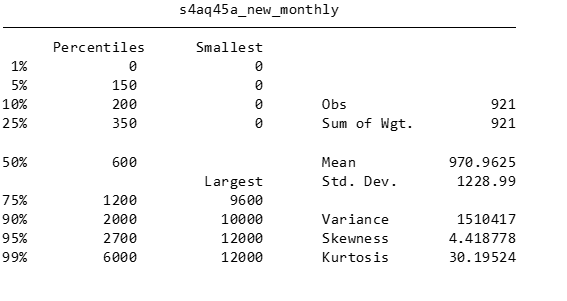
As the table show, the median cash income in Accra was 600 Ghana Cedis. The average cash income was nearly 1,000 Cedis (970.96 Ghana Cedis, to be exact). Income inequality is quite significant. The top 1% of the population (99th percentile) earn disproportionately more than everyone else. These incomes are, however, individual than household incomes and are cash only. The highest cash income was 12,000 Ghana Cedis.
Average incomes are affected by outliers
Generally, discussing incomes based on averages masks a lot of issues regarding earnings. Meagre and extremely high salaries can shift the average either downwards or upwards. People working in petrochemical and mining, finance, insurance, telecommunication, and aviation industries generally earn some of the highest incomes in the country. Expat salaries tend to be significantly higher than salaries of locals.
So, let's look at household incomes quintiles
An income quintile divides the population into five equal groups. Each group constitutes about 20% of the population. So, the first quintile is the lowest 20% of the people and so forth. In the case of Accra, the lowest quintile (1st) contributed only 1.1% of total income. The highest quintile (5th) contributed 58.6% of incomes earned in the region. In other words, the top 20% of the population made 58.6% of the total income earned in the region.
Quintile
Mean annual household income
(GH¢)
Mean annual per capita income
(GH¢)
Region
1
2
3
4
5
All
Greater Accra
1.1
3.6
9.7
26.9
58.6
100.0
64,701
21,592
Ghana
12.4
15.4
17.9
22.5
31.7
100.0
44,042
21,819
In Ghana, the highest quintile earned 54,371 Ghana Cedis per annum on average. Those in the lowest quintile made 7,783 Ghana Cedis per annum on average.
See Housing Statistics in Ghana
Sources of household income
Data from the GSS show that Accra’s largest source of household income was not from waged employment but nonfarm self-employment. Nonfarm self-employment contributed 85.8% and 82.3% of household income in Accra and the Greater Accra Region, respectively. Rental income contributes minimally to household income.
Across the country, those in nonfarm self-employment earned an average of 19,485 Ghana Cedis (gross) per annum compared to 5,172 Ghana cedis (gross) for wage earners―a difference of 277%.
Households’ sources of income by locality and region (%)
Wage income
from employment
Household agricultural income
Nonfarm self-employment income
Rental income (actual and imputed)
Remittance
Other income
Total
Urban
13.5
1.4
79.6
3.4
1.3
0.7
100.0
Other Urban
14.1
1.7
78.4
3.8
1.4
0.6
100.0
Greater Accra
12.6
0.5
82.3
3.1
0.9
0.7
100.
Accra
10.8
0.0
85.8
1.9
0.7
0.8
100.0
Regional distribution of households by quintile, average (mean) annual household and per capita income
Quintiles
Mean Annual Household income
Per Capita Income
Region
1
2
3
4
5
All
(GH¢)
(GH¢)
Western
11.4
20.9
21.2
24.2
22.2
100.0
30,862
9,058
Central
7.9
16.6
22.6
22.1
30.7
100.0
32,564
12,189
Greater Accra
1.1
3.6
9.7
26.9
58.6
100.0
64,701
21,592
Volta
22.9
24.7
21.0
17.8
13.6
100.0
31,612
7,394
Eastern
6.0
17.9
23.4
23.8
28.9
100.0
21,592
7,718
Ashanti
5.1
11.9
18.2
26.4
38.5
100.0
72,491
56,664
Brong Ahafo
15.0
19.9
22.1
22.0
21.0
100.0
30,710
12,606
Northern
41.1
22.7
14.6
11.1
10.6
100.0
22,919
5,748
Upper East
45.7
24.3
13.4
6.9
9.7
100.0
16,130
3,372
Upper West
56.6
20.6
9.0
8.0
5.7
100.0
12,958
3,604
Ghana
12.4
15.4
17.9
22.5
31.7
100.0
44,042
21,819
It is unclear how the Ashanti Region had a higher average income than the Greater Accra Region. Maybe it is the nature of sample distribution.
Notes
All data sourced from the GSS7
All incomes are gross
Ghana Statistical Service. (2019). Ghana Living Standard Survey Round 7 (GLSS 7). Accra
The post How much income households earn in Accra (Ghana) compared appeared first on Godwin Kavaarpuo.